Releases: microsoft/qdk
Release list
v1.31

Below are some of the highlights for the 1.31 release of the QDK.
Break & Continue
With this release, we have added support for the break and continue keywords to Q# and OpenQASM. This doesn't unlock any new runtime capabilities (as equivalent logic is expressible with existing loop and conditional constructs) but it does allow for much more concise and natural-looking code. For example in OpenQASM,
int[32] i = 0;

while (i < 10) {
    i += 1;
    // continue to the next loop iteration
    if (i == 2) {
        continue;
    }

    // some program

    // break out of loop
    if (i == 4) {
        break;
    }

    // more program
}
And in Q#,
operation Foo(q : Qubit[], stopAt : Int) : Unit {
    let n = Length(q);

    // Break and continue act on the innermost enclosing loop body
    // They can also appear in while and repeat bodies.
    for i in 1..n-2 {
        if i == stopAt {
            break;
        }
        if i % 2 == 0 {
            continue;
        }
        CX(q[0], q[i+1]);
    }
}
Running Q# tests from Python
Q# supports writing unit tests (as operations annotated with @Test). Previously, these were only runnable within the VS Code UI. Now you can use the qdk.test_utils.run_tests Python API to run all unit tests in your Q# package.
from qdk import qsharp
from qdk.test_utils import run_tests

qsharp.eval("""
import Std.Diagnostics.Fact;

@Test()
operation MyTest() : Unit {
    Fact(2 + 2 == 4, "assertion failed");
}
""")

run_tests()
Compile-time configuration
You can now specify a compile-time configuration (as a Python dictionary passed to qsharp.init or the qdk.Context constructor) and access it in Q# code using Std.Core.ConfigValue. Calls to Std.Core.ConfigValue will be replaced with the provided values at compilation time.
from qdk import qsharp, code

qsharp.init(qdk_config={"size": 10, "angle": 2.0})

qsharp.eval("""
import Std.Core.ConfigValue;

operation Foo() : Result[] {
    let size = ConfigValue("size", 1);
    let angle = ConfigValue("angle", 0.0);

    use qs = Qubit[size];

    for q in qs {
        Rx(angle, q);
    }
    MResetEachZ(qs)
}
""")

code.Foo()
See the https://github.com/microsoft/qdk/tree/main/source/qdk_package#configuration-map documentation for more details.
New Arithmetic library
A new library for advanced quantum arithmetic operations has been added. The library is available at https://github.com/microsoft/qdk/tree/main/library/arithmetic, and can be used by Q# projects as outlined in https://learn.microsoft.com/en-us/azure/quantum/how-to-work-with-qsharp-projects#configure-the-manifest-files.
Determine if running under Resource Estimation
You can now determine whether code is being executed in resource estimation mode via the new Std.ResourceEstimation.IsResourceEstimating API. This can be useful if you want different behavior for resource estimation versus running code on a simulator or quantum hardware.
For example, if you have a loop, you can use Std.ResourceEstimation.RepeatEstimates in resource estimation mode, and a for loop otherwise.
Classical arithmetic functions
When working on arithmetic algorithms, it can be useful to define an operation that applies a function to a quantum register without implementing it.
Now you can do this in Q# using Std.ArithmeticTestUtils.ApplyClassicalFunction. It takes an n-qubit quantum register and a Q# function f : (BigInt) -> BigInt that represents a bijection on 0..2^n-1. The effect of this operation is equivalent to applying a unitary operation that maps |x> to |f(x)>.
We also provide a multi-register version (Std.ArithmeticTestUtils.ApplyClassicalFunctionN).
For example, you can represent in-place addition (equivalent to Std.Arithmetic.IncByLE) as follows:
import Std.ArithmeticTestUtils.ApplyClassicalFunctionN;
operation IncByLE(xs : Qubit[], ys : Qubit[]) : Unit is Ctl {
    let mod = 1L << Length(ys);
    ApplyClassicalFunctionN(a -> [a[0], (a[0]+a[1])%mod], [xs, ys]);
}
Arithmetic test helpers
When writing tests for arithmetic operations, we typically allocate registers, write inputs to them, apply an operation, and read the outputs. We added a helper Std.ArithmeticTestUtils.TestArithmeticOp to do all that, which can be used in Q# unit tests.
We also added a convenient Python wrapper around TestArithmeticOp, called ArithmeticOpTester, that allows you to write unit tests for arithmetic operations in Python. For example, this is how to write a test for Std.Arithmetic.IncByLE that checks this operation on 5 random inputs:
import random
from qdk.test_utils import ArithmeticOpTester
n = 10
tester = ArithmeticOpTester("Std.Arithmetic.IncByLE", [n, n])
for _ in range(5):
    x, y = random.randint(0, 2**n - 1), random.randint(0, 2**n - 1)
    assert tester.run([x, y]) == [x, (x + y) % (2**n)]
This feature is intended for developing and testing quantum algorithms and is currently supported only by the sparse simulator.
Other notable changes
- Implement
PostSelectZfor Clifford simulation by Stefan J. Wernli (@swernli) in 3335 - Move openqasm parser out of the compiler by Ian Davis (@idavis) in 3387
- Document Std.Random callables as simulation-only by Andrew Casey (@amcasey) in 3450
- Standardize error codes with "Qdk." prefix by João Boechat (@joao-boechat) in 3420
- Fix Typo in "|0〉, |+〉 or Inconclusive?" Kata by Kavin Muralikrishnan (@Advay17) in 3457
- Fix unexpected loop variables in partial eval by falling back to static values by Stefan J. Wernli (@swernli) in 3456
- Type checking for Python code by Dima Fedoriaka (@fedimser) in 3382
- Update prepare/select scoping rules in stim by João Boechat (@joao-boechat) in 3454
- Send telemetry for wasm panics by Andrew Casey (@amcasey) in 3443
- Move VS Code AI files into special folder by Andrew Casey (@amcasey) in 3468
- Updated TM grammar by Filip W (@filipw) in 3444
- Add Python type annotations by Dima Fedoriaka (@fedimser) in 3467
- Paulimer upgrade by orpuente-MS in 3465
- [Context] Use _get_context_or_default in global APIs by Dima Fedoriaka (@fedimser) in 3429
- Running Q# tests from Python by Dima Fedoriaka (@fedimser) in 3423
- Arithmetic test utils by Dima Fedoriaka (@fedimser) in 3400
- Support negated targets in stim collapsing gates by João Boechat (@joao-boechat) in 3455
- Handle loss in stim control flow by João Boechat (@joao-boechat) in 3459
- fix deprecated assign update expression for nested expressions by Dhairya Patel (@HABER7789) in 3482
- update deq language by Yue Wu (@yuewuo) in 3466
- Handle corrupt kata progress by Andrew Casey (@amcasey) in 3472
- Katas use Auto if Haiku 4.5 unavailable by Andrew Casey (@amcasey) in 3473
- Add Std.ResourceEstimation.IsResourceEstimating intrinsic by Dima Fedoriaka (@fedimser) in 3132
- switch OpenQASM grammar from variable length to fixed length lookbehind by Filip W (@filipw) in 3480
- Avoid spurious out-of-bounds error on iterating over empty array by Stefan J. Wernli (@swernli) in 3490
- allow repeat-until loops in functions by Dhairya Patel (@HABER7789) in 3489
- Std.Core.ConfigValue by Dima Fedoriaka (@fedimser) in 3486
- docs: added link to playground by . (@dibrinsofor) in 3475
- Recursive HOF specialization remaps self call to specialization by Ian Davis (@idavis) in 3458
- Add classical output recording to QIR simulators by orpuente-MS in 3435
- Raise Python type checking level to Standard by Dima Fedoriaka (@fedimser) in 3496
- Prevent divergent types from flowing out of loop and conjugate exprs by Stefan J. Wernli (@swernli) in 3507
- Allow blocks in interpolated string expressions by Dhairya Patel (@HABER7789) in 3503
- [Stim] Optimize noise intrinsic emission and support more noise instructions by João Boechat (@joao-boechat) in 3484
- [STIM] SELECT block improvements + support for REPEAT by João Boechat (@joao-boechat) in 3499
- Fix a bug in Compiler::new by Dima Fedoriaka (@fedimser) in 3509
- Support qdk_config in qsharp.init (and rename qsharp_config to qdk_config) by Dima Fedoriaka (@fedimser) in 3504
- Update grammar file by Scott Carda (@ScottCarda-MS) in 3508
- npm fixes by Bill Ticehurst (@billti) in 3519
- Switch from fat to thin lto by João Boechat (@joao-boechat) in 3524
- Break and continue support by Ian Davis (@idavis) in 3451
- Add arithmetic library by Dima Fedoriaka (@fedimser) in 3523
- Reference tes...
Contributors


Assets 2
v1.30.0
Below are some of the highlights for the 1.30 release of the QDK.
Adaptive profile capabilities
QIR is the industry standard format that the QDK compiles programs into from various quantum languages (Q#, OpenQASM, Qiskit, etc), and is how programs are sent to quantum computers for execution, such as through Azure Quantum. It is also the format some of the QDK simulators use, such as the Stabilizer and GPU state vector simulators.
QIR specifies different profiles that dictate what instructions it may contain, and the profile may contain optional features. In this release, we have added a number of these "optional" features in the code generation for the "Adaptive" profile.
Several of these features don't directly affect what your code can express, but they can significantly impact performance. For example, by being able to directly express loops (rather than having to unroll them) and calls (rather than having to inline them) compilation time can be greatly reduced and compiled program size significantly decreased. In the most notable cases internally, we observed both improve by orders of magnitude.
One concrete example of a newly supported capability is unbounded loops, such as the "repeat-until-success" pattern. The below is a contrived but minimal example of a "repeat-until-success" loop that now compiles to QIR. (Previously, this would have given a "cannot have a loop with a dynamic condition" error).
@EntryPoint(Adaptive)
operation Main() : Int {
    mutable iterations = 0;
    use qubit = Qubit();

    // Loop until the measurement of the qubit in the Z basis returns One
    repeat {
        iterations += 1;
        Rx(0.1, qubit);
    } until MResetZ(qubit) == One;

    // Return the number of iterations it took to measure the desired state
    iterations
}
The Adaptive capabilities are a work in progress. Please check the wiki page at https://github.com/microsoft/qdk/wiki/QIR for the latest capabilities, limitations, and known issues. As always, please log an issue at https://github.com/microsoft/qdk/issues for any bugs, questions, or feature requests.
New quick-fixes
Several new Quick Fixes have been added this release. The first is to add missing import statements.
import-quickfix.mp4
Another common coding error is to pass a single qubit where a qubit array was expected, such as in Controlled functors.
For example, the code Controlled SX(qs[0], qs[1]); gives an error of "type error: expected Qubit[], found Qubit", and the "Convert to single element array" Quick Fix will change the code to be Controlled SX([qs[0]], qs[1]);, resolving the error.
Simulator loss policies
The noise model that can be applied to quantum simulations now support specifying a "loss policy", which describes the behavior of a two-qubit gate when one of the qubits is lost.
Previously the behavior was always to skip the two-qubit operation if one qubit is marked as "lost". This makes sense, for example, if mathematically you treat a lost qubit as being in the
from qdk.simulation import NoiseConfig, LossPolicy, run_qir
qir = ... # get the compiled program

noise = NoiseConfig()
noise.cz.on_loss   = LossPolicy.SKIP               # if one of the qubits is lost, skip the unitary
noise.cx.on_loss   = LossPolicy.PROPAGATE          # if one of the qubits is lost, lose the other one also
noise.rxx.on_loss  = LossPolicy.DEGRADE            # degrade to a single qubit gate, i.e. rx on the remaining qubit
noise.ryy.on_loss  = LossPolicy.RESIDUAL_S_DAGGER  # apply an S_DAG to the remaining qubits
noise.swap.on_loss = LossPolicy.APPLY_ANYWAY       # if swap is implemented as a relabel, then it still applies

# Works with all simulator types, in any profile.
run_qir(qir, shots=100, noise=noise, type="clifford")
Other notable changes
- Support --editable flag by Bill Ticehurst (@billti) in 3224
- Bump rand by Bill Ticehurst (@billti) in 3239
- Add correlated noise sample by orpuente-MS in 3264
- Fix stale selection in Learning panel by Andrew Casey (@amcasey) in 3265
- Add some tests to validate the qsharp API surface by Scott Carda (@ScottCarda-MS) in 3270
- Handle missing rparen on call by Andrew Casey (@amcasey) in 3279
- Add
frem,fptoui,uitofpinstructions to QIR simulators by orpuente-MS in 3268 - Updates to qubit models by Mathias Soeken (@msoeken) in 3257
- Add default
dim=2to Cirq QRE qubit managerqallocAPIs by Dima Fedoriaka (@fedimser) with @Copilot in 3293 - Gray out excluded code by Sorin Bolos (@sorin-bolos) in 3295
- Add auto-import quickfix for unresolved names by Sorin Bolos (@sorin-bolos) in 3294
- feat: supported openqasm support to the playground along with its ast, hir and rir by Mintu Gogoi (@Gmin2) in 3289
- Surface multiple solutions for katas that have them by Andrew Casey (@amcasey) in 3275
- Update error span for call argument type mismatch by Andrew Casey (@amcasey) in 3287
- feat(python): load visual circuits directly in Context by 0_o_c (@tzh476) in 3291
- add deq language syntax highlight by Yue Wu (@yuewuo) in 3316
- Update Python API to avoid private types in public signatures by Scott Carda (@ScottCarda-MS) in 3278
- Fix panic in call expr type inference by Andrew Casey (@amcasey) in 3314
- Rename
Adaptive_RIFLAto justAdaptiveby Stefan J. Wernli (@swernli) in 3338 - Add a code fix for should-have-been-array by Andrew Casey (@amcasey) in 3330
- Track dynamic constants across call boundaries in RCA by Stefan J. Wernli (@swernli) in 3349
- Add initial support for simple IR functions in QIR by Ian Davis (@idavis) in 3344
- Add a helper to get action of an operation on a state by Dima Fedoriaka (@fedimser) in 3300
- Update service.ts to so that pressing next on the last kata works by xhaidendsouza in 3354
- Fix for reading
qdk.qir.profilepragma in playground by Stefan J. Wernli (@swernli) in 3371 - Stim compiler by João Boechat (@joao-boechat) in 3305
- Added (Majorana) fermions to basic operator types. by Brad Lackey (@brad-lackey) in 3360
- Simplify M to intrinsic def by Ian Davis (@idavis) in 3381
- Add code fix for double literal without dot by Andrew Casey (@amcasey) in 3352
- Have RCA reject unsafe qubit release from dynamic context by Stefan J. Wernli (@swernli) in 3395
- Add Adaptive target profile completions and OpenQASM pragma/annotation completions by Ian Davis (@idavis) in 3396
- Update default profile selection. by Ian Davis (@idavis) in 3399
- Increase adaptive GPU shader max registers by orpuente-MS in 3402
- Fix pauli noise on qubit registers by orpuente-MS in 3405
- Add tests for the Stim compiler by orpuente-MS in 3376
- Workspace links by Bill Ticehurst (@billti) in 3404
- Fix QIR generation panic on mutable qubit variables by Stefan J. Wernli (@swernli) in 3411
- Types for target modeling (qubit, QECStrategy, Target) and tests by Mathias Soeken (@msoeken) in 3414
- Add support for PREPARE block in stim by João Boechat (@joao-boechat) in 3409
- Allow adaptive
NeutralAtomDevicesimulation by orpuente-MS in 3413 - Syntax Highlighting for Stim Grammar by Scott Carda (@ScottCarda-MS) in 3385
- Support classically controlled gates in Stim by João Boechat (@joao-boechat) in 3417
- Add loss policies to
NoiseConfigto express different kinds of behavior on lost qubits by orpuente-MS in 3302 - Fallback to profile used in init if any during openqasm.compile Stefan J. Wernli (@swernli) in 3436
New Contributors
- Sorin Bolos (@sorin-bolos) made their first contribution in 3295
- Mintu Gogoi (@Gmin2) made their first contribution in 3289
- 0_o_c (@tzh476) made their first contribution in 3291
- Yue Wu (@yuewuo) made their first contribution in 3316
- xhaidendsouza made their f...
Contributors


Assets 3
v1.29.0
QDK Learning experience
This release introduces a new learning experience that tightly integrates the QDK developer tools with GitHub Copilot.
With learning content now in the same rich environment used to develop quantum programs, backed by the latest AI models and editor integration from VS Code and GitHub Copilot, you can rapidly switch between learning, experimenting, and developing.
To get started, navigate to the new Microsoft Quantum icon on the activity bar (see next section), and click on Start learning. Copilot will then create a folder structure in your current workspace to track progress, bring up a list of lessons to work through, and help guide you through exercises, answer questions, or explore concepts further.
kata-sm2.mp4
If you need help getting GitHub Copilot configured in VS Code, see the docs at https://code.visualstudio.com/docs/copilot/setup.
This is a new feature and we will continue iterating on the experience. As always, if you have any suggestions or encounter any issues, please log them at https://github.com/microsoft/qdk/issues .
New Microsoft Quantum icon in the VS Code activity bar
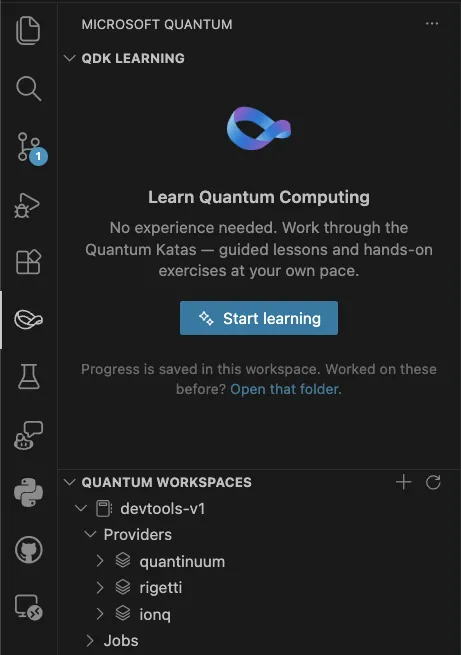
In this release we have added a Microsoft Quantum area to the VS Code Activity Bar, identified by the Möbius strip icon. This area contains the new QDK Learning experience outlined above, and is the new home for the Quantum Workspaces container for connecting to Azure Quantum that previously lived in the Explorer view.
Deprecation of the qsharp Python package
With this release we have moved the Python implementation out of the qsharp package and into the qdk package, and marked the qsharp package as deprecated. If you import directly from the qsharp package in Python you will get a warning to use the qdk package and its submodules instead.
Besides the warning, there should be no change in functionality during the transition. We encourage you to update any code that imports directly from qsharp to use this new pattern, as the deprecated package will stop shipping in a future release.
Clifford simulation
When using the Python APIs qdk.qsharp.run or qdk.openqasm.run to run a quantum simulation, you may now pass a type="clifford" argument to indicate that the simulation should run on the Clifford simulator rather than the default sparse simulator.
Clifford simulation scales to a much higher number of qubits, but only supports a restricted set of quantum operations. See the page at https://learn.microsoft.com/en-us/azure/quantum/simulators-overview-qdk for more details.
Isolated Python context
Previously when evaluating or running Q# or QASM code in a Python environment, all interactions occurred in a single global interpreter. This reliance on global state was less than ideal for code that expected a clean environment. This release includes a new qdk.Context API to create a separate quantum interpreter from the global one. The returned context has an API similar to the top level API, e.g.
import qdk

ctx = qdk.Context()
ctx.eval("operation Main() : Result { use q = Qubit(); X(q); MResetZ(q) }")
assert ctx.run("Main()", 2) == [qdk.Result.One, qdk.Result.One]
See the PR at 3208 for more details.
Custom parameters for job submission via VS Code
The Python API to submit jobs to the Azure Quantum service has always had the ability to attach custom parameters with job submission. With this release, we've added the ability to set per-target custom parameters in VS Code, which will then be attached to any job submitted via the Quantum Workspaces tree view or GitHub Copilot tools.
See the PR at 3222 for more details.
Update Python API documentation
The Python API documentation has been cleaned up and refreshed for this release. The improvements should be noticeable both in the Python code editor via IntelliSense, as well as the online documentation at https://learn.microsoft.com/en-us/python/qdk/qdk
Other notable changes
- Provide lhs_span to binop errors when necessary by João Boechat (@joao-boechat) in 3185
- Enable Clifford simulation in
qsharp.runby Stefan J. Wernli (@swernli) in 3164 - Optimize H/Rx/Ry in sparse sim by Stefan J. Wernli (@swernli) in 3196
- Fix azure error logging by João Boechat (@joao-boechat) in 3197
- Fix debugger error formatting in circuit panel by João Boechat (@joao-boechat) in 3191
- Move contents of
qsharppython package toqdkpython package by Scott Carda (@ScottCarda-MS) in 3192 - Compute runtime of a trace by Mathias Soeken (@msoeken) in 3209
- QREv3 neutral atom models by Mathias Soeken (@msoeken) in 3211
- Replace deprecated Microsoft.Quantum._ namespace references with Std._ in library tests by @Copilot in 3161
- Added 8T->CCX and cultivation models by Mathias Soeken (@msoeken) in 3212
- Add Context API by Dima Fedoriaka (@fedimser) in 3208
- Add array support to QIR bytecode by orpuente-MS in 3219
- Custom Job Params for Targets by Scott Carda (@ScottCarda-MS) in 3222
- Improve performance of
OutputRecordingPasswhen processing QIR simulation results by Stefan J. Wernli (@swernli) in 3235 - Make prereqs.py specific about rust version by Andrew Casey (@amcasey) in 3231
- Fix output processing on failed simulation by Stefan J. Wernli (@swernli) in 3237
- Add interactive Quantum Katas learning experience to VS Code extension by Mine Starks (@minestarks) in 3228
- Manual Memory-Compute qubits by Dima Fedoriaka (@fedimser) in 3204
- Learning panel: click-to-navigate, exercise reset, and layout cleanup by Mine Starks (@minestarks) in 3249
- Updated source, docstrings, and tests for qdk.magnets.trotter by Brad Lackey (@brad-lackey) in 3226
- Update Python API Doc Strings by Scott Carda (@ScottCarda-MS) in 3225
New Contributors
- Andrew Casey (@amcasey) made their first contribution in #3231
Full Changelog: v1.28.0...v1.29.0
Contributors

Assets 3
v1.28.0
Below are some of the highlights for the 1.28 release of the QDK.
Resource Estimation v3
The Quantum Resource Estimation feature has been significantly rewritten to be far more capable of modeling and estimating quantum resource requirements across languages, frameworks, architectures, and modalities.
The new implementation is being rolled out in phases, and this initial release includes the Python APIs. The old QRE Python APIs and the VS Code Estimate CodeLens experience are now marked as deprecated.
For more details on the new APIs and examples of their usage, see the QREv3 wiki page.
Improved simulator capabilities
In this release, we have exposed Python APIs to run QIR directly on the underlying simulators (the CPU state vector, Clifford, and density matrix simulators, and the GPU state vector simulator). The simulators have also been updated to handle programs generated for the "QIR Adaptive Profile", meaning the quantum programs they run may contain mid-circuit measurements, conditional branching, loops, etc.
See the QDK Simulators wiki page for more details.
VS Code extension hosting
The VS Code extension hosting has been updated from being purely a web extension to being run in the local Node.js host when running on a desktop VS Code instance. This fixes issues that could be encountered when running in remote configurations, such as when using WSL. This also lays the groundwork for future work on more agentic flows that require interacting with other local Node.js or Python processes (such as MCP Agents).
Debugger "Break on entry"
The integrated quantum debugger for Q# and OpenQASM used to always break on the first statement when launched. This now defaults to false. This can be configured via launch.json in VS Code, e.g.
{
  "name": "Debug Q# file",
  "type": "qsharp",
  "request": "launch",
  "program": "${workspaceFolder}/samples/algorithms/Grover.qs",
  "stopOnEntry": true
}
Other notable changes
- Simplify debugger breaking by João Boechat (@joao-boechat) in #3034
- Introduce QIR v2.1 Profile
Adaptive_RIFLAby Stefan J. Wernli (@swernli) in #3037 - Improvements to Q# library documentation by Filip W (@filipw) in #3083
- Optimize
PreparePureStateDby Stefan J. Wernli (@swernli) in #3048 - Add loop emission to
Adaptive_RIFLAby Stefan J. Wernli (@swernli) in #3038 - Ignore dynamic
Factby Stefan J. Wernli (@swernli) in #3098 - Bump wgpu by Bill Ticehurst (@billti) in #3100
- add
DecomposeCcxPasstorun_qir_cpuby orpuente-MS in #3107 - Enable running the VS Code extension host on the workspace (Node.js) by default by João Boechat (@joao-boechat) in #3093
- Use separate browser/node entrypoints instead of runtime environment detection by Mine Starks (@minestarks) in #3121
- Bump quantum-sparse-sim to v0.9.4 by Dima Fedoriaka (@fedimser) in #3122
- RIFLA: Support emission of loops over constant arrays by Stefan J. Wernli (@swernli) in #3101
- Sccarda/python docs update by Scott Carda (@ScottCarda-MS) in #3131
- Copy sparse simulator into QDK by Stefan J. Wernli (@swernli) in #3137
- Upgrade pyqir to v0.12.3 by orpuente-MS in #3130
- RIFLA: Support iteration over arrays of qubits by Stefan J. Wernli (@swernli) in #3103
- QRE Update by Mathias Soeken (@msoeken) in #3090
- Update Python Docs for
qdkpackage by Scott Carda (@ScottCarda-MS) in #3144 - Copilot skill file updates by Mine Starks (@minestarks) in #3154
- Remove legacy Jupyter CodeMirror Q# syntax highlighting injection by @Copilot in #3140
- Fix run command hanging on compile errors for OpenQASM and Q# programs by Mine Starks (@minestarks) in #3155
- Re-export python simulators from
qdk.simulationby orpuente-MS in #3145 - Default to OpenQASM semantics on compile by Stefan J. Wernli (@swernli) in #3167
- Align gpu and cpu loss behavior by orpuente-MS in #3129
- Adaptive Profile support for CPU-full-state and Clifford simulators by orpuente-MS in #3086
- Sample notebooks for QRE update by Mathias Soeken (@msoeken) in #3110
- Add orbital entanglement diagram widget by Jan Unsleber (@nabbelbabbel) in #2974
- Add deprecation messages for current QRE by Mathias Soeken (@msoeken) in #3170
New Contributors
- Jan Unsleber (@nabbelbabbel) made their first contribution in #2974
Full Changelog: v1.27.0...v1.28.0
Contributors

Assets 2
v1.27.0
Below are some of the highlights for the 1.27 release of the QDK.
Local neutral atom simulation for Cirq and Qiskit
You can now run your Cirq and Qiskit circuits on the local neutral atom simulator. The new NeutralAtomSampler (for Cirq) and NeutralAtomBackend (for Qiskit) let you submit circuits and simulate noisy neutral atom hardware locally, including qubit loss modeling.
For Cirq, the sampler implements cirq.Sampler, so it integrates seamlessly with existing Cirq workflows. Results include both a standard Cirq-compatible view (with loss shots filtered out) and raw data with loss markers for more detailed analysis:
from qdk.cirq import NeutralAtomSampler
from qdk.simulation import NoiseConfig

noise = NoiseConfig()
noise.rz.loss = 0.08
result = NeutralAtomSampler(noise=noise, seed=42).run(circuit, repetitions=1000)
For Qiskit, the backend provides a NeutralAtomTarget and transpiles circuits into the native gate set (rz, sx, cz):
from qdk.simulation import NeutralAtomBackend, NoiseConfig

backend = NeutralAtomBackend()
native_circuit = transpile(circuit, backend=backend)
job = backend.run(native_circuit, shots=1000, noise=NoiseConfig())
See the neutral atom simulator sample notebook for a walkthrough.
Updated samples for circuit compatibility
Many of the built-in samples have been updated so they can now generate circuit diagrams and be submitted to Azure Quantum. Previously, some samples used patterns that were incompatible with circuit generation, such as Message calls with dynamic values. These checks have been relaxed, and the samples have been restructured so that Main() is circuit-compatible while validation logic lives in separate @Test() operations. See #2999 for details.
PostSelectZ operation
A new operation, Std.Diagnostics.PostSelectZ, allows a program to force the collapse of a given qubit to a specified state in the computational basis. This is useful in simulation (including simulation for circuit generation) and resource estimation. It is ignored during QIR code generation, so it does not affect hardware execution. See #3017 for details.
Circuit visualization improvements
Classically controlled gate groups can now be expanded and collapsed in circuit diagrams, matching the behavior of other expandable groups. This provides a more consistent interaction model when exploring circuits with complex classical control flow. See #2985 for details.
Other notable changes
- Add support for Adaptive_RIFL QIR programs in GPU simulator by orpuente-MS in #3039
- Support
NoiseConfigfor Q# and OpenQASM on sparse simulation by Stefan J. Wernli (@swernli) in #3062 - Support explicit seed in
qsharp.runby Stefan J. Wernli (@swernli) in #3065 - Add
qdk-programmingCopilot skill for Q#, OpenQASM and Python by Mine Starks (@minestarks) in #3058 - Add Optional Data Overlay for MoleculeViewer by David Williams-Young (@wavefunction91) in #3059
- RCA: Allow updates to mutable variables within a dynamic scope if the variable is also defined within that scope by Stefan J. Wernli (@swernli) in #3053
- OpenQASM: Fix const propagation in bitarray-to-int promotion by Mine Starks (@minestarks) in #3030
- Add
IntAsDoubleandTruncatesupport in QIR by Stefan J. Wernli (@swernli) in #3024 - Fix collapse/expand issue by Scott Carda (@ScottCarda-MS) in #3016
- Refactor RCA by Stefan J. Wernli (@swernli) in #2835, #3015
Full Changelog: v1.26.1...v1.27.0
Contributors

Assets 3
v1.26.0
Below are some of the highlights for the 1.26 release of the QDK.
Conditional branches in circuit diagrams
With this release, branches based on measurement results (e.g., if (M(q) == One) { ... }) are now shown in circuit diagrams as classically controlled operations, with a label indicating the measurement result that triggers the branch. This makes it easier to understand the structure of algorithms that involve mid-circuit measurements and classical control flow.
Note that the expression in the condition may result from complex processing on multiple measurement results, and the circuit will trace and correctly show the results involved in the condition, for example:
import Std.Math.PI;
operation Main() : Result {
    use q = Qubit();
    use reg = Qubit[2];

    ApplyToEach(H, reg);
    let num = MeasureInteger(reg);

    if num == 3 {
        Y(q);
    } else {
        Rx(PI() / 4.0, q);
    }

    MResetZ(q)
}
As with other circuit operations or gates, clicking on the box for a conditional branch will navigate to the corresponding source code location.
Quantum state visualizer in the circuit editor
The Quantum Circuit Editor now includes a state visualizer panel that shows the resulting quantum state from running the circuit, with live updates as the circuit is edited. It visualizes the probability density and phase for each basis state. The panel may be collapsed or expanded by clicking on the vertical divider.

Python improvements for language interop
You can now import OpenQASM code and use it directly as a Q# operation via import_openqasm:
from qdk.openqasm import import_openqasm
from qdk import qsharp

import_openqasm("""
    include "stdgates.inc";
    qubit[2] qs;
    h qs[0];
    cx qs[0], qs[1];
""", name="Entangle")

qsharp.eval("{ use qs = Qubit[2]; Entangle(qs); MResetEachZ(qs) }")
# [One, One]
The QDK now also supports passing Q# callables across the Python boundary, enabling advanced coding patterns for composable code. Continuing from the sample above, we can define a Q# operation that takes another operation as an argument, and pass the code we imported from OpenQASM:
qsharp.eval("""
operation TestAntiCorrelation(entangler : Qubit[] => Unit) : Result[] {
    use qs = Qubit[2];
    X(qs[1]);
    entangler(qs);
    MResetEachZ(qs)
}
""")

from qsharp.code import Entangle, TestAntiCorrelation

TestAntiCorrelation(Entangle)
# [Zero, One]
Support for doc comments on struct fields
Doc comments on struct fields are now shown in the hover text for the field in VS Code. See the description in the PR at #2891 for details.
New Table Lookup sample
We added a Hypercube Lookup sample demonstrating usage of the recently added table lookup library. See the extensive comments in the sample's Main.qs file for details.
Other notable changes
- Use 'build' package to build wheels by Ian Davis (@idavis) in [#2822]#2822
- Introduce a new lint: avoid block namespace by Filip W (@filipw) in [#2862]#2862
- Fix copilot histogram display by Bill Ticehurst (@billti) in [#2886]#2886
- Show doc comments on hover of struct fields by Stefan J. Wernli (@swernli) in [#2891]#2891
- Creating an explicit namespace with the same name as a callable breaks Python interop by Stefan J. Wernli (@swernli) in [#2896]#2896
- Unresolved names in call expression avoid ambiguous type error by Stefan J. Wernli (@swernli) in [#2892]#2892
- Fix issue with shadowing in
qsharp.codeby Stefan J. Wernli (@swernli) in [#2908]#2908 - CSS updates by Bill Ticehurst (@billti) in [#2899]#2899
- Fix
**kwargstypehints by orpuente-MS in [#2884]#2884 - Combine kernels for op application by Bill Ticehurst (@billti) in [#2898]#2898
- Better feedback on incorrect syntax for qubit allocation by Stefan J. Wernli (@swernli) in [#2897]#2897
- Table lookup sample by DmitryVasilevsky in [#2910]#2910
- Add QIR noise intrinsic by orpuente-MS in [#2915]#2915
- Pointing to windows-2025 image on SDLSources stage by igormasson in [#2918]#2918
- Ket Labels on Results from Azure by Scott Carda (@ScottCarda-MS) in [#2917]#2917
- Deprecate
borrowkeyword with Lint and Code-Action by Scott Carda (@ScottCarda-MS) in [#2929]#2929 - [VSCode] Update to latest Quantum DP and CP api-version by Xinyi Joffre (@xinyi-joffre) in [#2922]#2922
- Atom visualizer improvements by Bill Ticehurst (@billti) in [#2935]#2935
- Add
load_csv_dirmethod toNoiseConfigclass by orpuente-MS in [#2928]#2928 - Added CY gate to GPU, CPU and Clifford simulators by DmitryVasilevsky in [#2927]#2927
- Circuit Editor State Visualization Panel by Scott Carda (@ScottCarda-MS) in [#2870]#2870
- Allow Passing of Q# callables and closures in Python by Stefan J. Wernli (@swernli) in [#2940]#2940
- Use tagged aggregates in QIR by Stefan J. Wernli (@swernli) in [#2964]#2964
- Change
import_openqasmto hoist qubits into the arguments of the generated Q# operation by Stefan J. Wernli (@swernli) in [#2920]#2920 - Sign vsix before publishing by Ian Davis (@idavis) in [#2967]#2967
- Get VSCode Extension, Manifest, and Signature files for Publishing by Ian Davis (@idavis) in [#2969]#2969
- Reset gate and MZ in addition to MResetZ in GPU simulator by DmitryVasilevsky in [#2939]#2939
- Remove container creation when retrieving linked storage account from the service by Zulfat Nutfullin (@rigidit) in [#2968]#2968
- Update azure-quantum Python dependency by Stefan J. Wernli (@swernli) in [#2976]#2976
- [Circuit Diagrams] 1 - RIR debug metadata by Mine Starks (@minestarks) in [#2942]#2942
- [Circuit Diagrams] 2 - ASCII art changes to render conditionals and complex groups by Mine Starks (@minestarks) in [#2944]#2944
- [Circuit Diagrams] 3 - SVG rendering changes for classically controlled circuits by Mine Starks (@minestarks) in [#2945]#2945
- [Circuit diagrams] 4 - Show conditionals in circuits based on RIR debug metadata by Mine Starks (@minestarks) in [#2943]#2943
- Fix zoom behavior in circuit diagrams by Mine Starks (@minestarks) in [#2979]#2979
New Contributors
- igormasson made their first contribution in #2918
- Zulfat Nutfullin (@rigidit) made their first contribution in #2968
Full Changelog: v1.25.1...v1.26.0
Contributors


Assets 3
v1.25.1
Below are some of the highlights for the 1.25 release of the QDK.
Branding update
The QDK has been updated to reflect Microsoft's branding for quantum computing, including updating the name of the VS Code extension to "Microsoft Quantum Development Kit" and updating the extension logo to the Mobius strip design.

New simulators
This release includes two new quantum simulators designed to provide high-performance noisy simulation and the ability to model qubit loss, which is an important "noise" consideration for neutral atom quantum hardware.
-
The Clifford simulator efficiently simulates circuits composed of Clifford operations, and can scale to thousands of qubits and run thousands of shots in seconds. This simulator is ideal for simulating error correction codes or other research involving Clifford circuits.
-
The GPU simulator uses GPU acceleration to simulate shots in parallel with high fidelity noise models. By leveraging the parallel processing power of modern GPUs, this simulator can handle wider (up to 27 qubits) and deeper circuits while modeling realistic noise and provide an order of magnitude speed-up over other simulators for certain challenging circuit types. By using a cross-platform GPU library, this simulator works on Windows, macOS, and Linux systems with compatible GPUs. (It will fall back to CPU simulation if no compatible GPU is found.)
Both simulators are currently exposed via the new NeutralAtomDevice Python class, and the noise models can be specified via the NoiseConfig class, both available in the qdk.simulators module. See the Benzene and Carbon sample notebooks for examples of using these simulators.
When running the simulators with qubit loss configured, lost qubits will be indicated in the measurement results with the special Loss result value when using raw labels, or with a - character when using ket labels.

Neutral Atom device visualizer
The NeutralAtomDevice class includes a show_trace method that takes the compiled program and visualizes the execution on an animated representation of a neutral atom device. This allows users to see how qubits are manipulated over time, including gate operations, measurements, and movement. This visualization can help with understanding the unique characteristics of neutral atom hardware, and how programs map to operations on the physical device. See the notebooks mentioned in the prior section for example usage.
nad.mp4
Circuit visualization improvements
In circuit diagrams, loops (for, while, etc.) from the source code are now represented as expandable components. This makes for a more compact and readable diagram, especially for iterative algorithms.
This release also includes other usability improvements to circuit diagrams, including labels at the top of expanded components, the ability to navigate to the call site of an operation by clicking on the corresponding component in the circuit diagram, and automatic expansion of trivial components.
circuits.mp4
Molecule visualizer
A MoleculeViewer class has been added to the collection of widgets (from qdk.widgets import MoleculeViewer) that can display 3D visualizations of molecules using data in .xyz and .cube formats. This is most useful when used in conjunction with the new qdk-chemistry package, which provides advanced tools for quantum chemistry exploration.

TableLookup library
A Table Lookup library has been implemented that provides efficient quantum implementations of table lookup operations. This library can be used to implement oracles for algorithms such as Grover's search, or to load classical data into quantum states for other algorithms. See https://github.com/microsoft/qdk/tree/main/library/table_lookup for the source, and the Configure Q# projects as external dependencies documentation for how to reference libraries in your Q# projects.
Other notable changes
- Update the pip install commands in notebook samples for qdk by Scott Carda (@ScottCarda-MS) in #2811
- Split OpenQASM into parser and compiler crates by Ian Davis (@idavis) in #2804
- Removing deps that are no longer needed by Ian Davis (@idavis) in #2814
- Update PyO3 to v0.27.2 by orpuente-MS in #2816
- Propagating missing information in logical counts by Mathias Soeken (@msoeken) in #2817
- Add debugger visualization for arrays by Ian Davis (@idavis) in #2812
- Add optional
prune_classical_qubitssetting for circuit generation by Stefan J. Wernli (@swernli) in #2802 - Updated comment to trig functions to mention radians by DmitryVasilevsky in #2825
- Update RIR reindex pass to avoid using extra qubits due to initial resets by Stefan J. Wernli (@swernli) in #2829
- Circuit diagrams: Show source code links for grouped operations by Mine Starks (@minestarks) in #2826
- Panic in Language Service: unexpected expr type in assignment by Stefan J. Wernli (@swernli) in #2833
- Prohibit return statements in apply block by Stefan J. Wernli (@swernli) in #2839
- Panic in QIR generation: "only some primitive types are supported" by Stefan J. Wernli (@swernli) in #2831
- Add functor constraint pass to OpenQASM compiler by orpuente-MS in #2838
- Circuit diagrams: auto-expand all single nested operations by Mine Starks (@minestarks) in #2842
- Fixed angle adjustment size bug by Filip W (@filipw) in #2845
- Circuit diagrams: Group loops by Mine Starks (@minestarks) in #2827
- First version of table lookup library by DmitryVasilevsky in #2834
- Circuit diagrams: Enable group_by_scope by default by Mine Starks (@minestarks) in #2848
- Circuit diagrams: Add label above expanded groups by Mine Starks (@minestarks) in #2843
- Support QDK_PYTHON_TELEMETRY environment variable by Mine Starks (@minestarks) in #2858
- Update branding to Microsoft Quantum by Mine Starks (@minestarks) in #2857
- Change logo to mobius strip by Bill Ticehurst (@billti) in #2860
- Move theme logic by Bill Ticehurst (@billti) in #2861
- Add sims and widgets by Bill Ticehurst (@billti) in #2863
Full Changelog: v1.23.0...v1.25.1
Contributors
Assets 3
v1.23.0
Below are some of the highlights for the 1.23 release of the QDK.
Full Qiskit 2 support
The qdk python package has been updated to support Qiskit 2 circuit submission to the Azure Quantum service. This is done via the AzureQuantumProvider class to get a backend object that can run both Qiskit v1 and v2 circuits. This allows for a simpler submission of Qiskit circuits to Azure as compared to the older approach that required manual QIR compilation before submission. The resulting job objects also handle parsing of the Qiskit output format. The pattern will look similar to:
provider = AzureQuantumProvider(workspace)
backend = provider.get_backend(target_name)
job = backend.run(circuit, shots, job_name)
counts = job.result().get_counts(circuit)
See the updated Qiskit submission sample notebook for the new supported method of Azure submission with Qiskit 2.
To make sure you get the updated qdk package with this support, please use the command pip install "qdk[azure,qiskit]" --upgrade
Interactive Circuit Diagrams with Source Code Navigation
Circuit diagrams now display clickable source code locations for gates and qubits in VS Code. Click on any operation box to jump directly to where it was called in your Q# or QASM code, or on a qubit label to jump to its declaration site. In Python Jupyter notebooks, source locations can be enabled via qsharp.circuit(source_locations=True) to display hover text with code locations.

Program output in VS Code Terminal
When running a Q# program in VS Code, the output is now displayed in the Terminal instead of the Debug Console, which is more consistent with other VS Code experiences. (When debugging, the output will still be displayed in the Debug Console.)
Fix display of job results listing
Previously, the job results listing in the VS Code "Quantum Workspaces" explorer view was not displaying correctly if the workspace contained a large number of jobs. This has now been fixed.
Minimum Python version is 3.10
The minimum Python version for the QDK packages has been updated to 3.10, as Python 3.9 is now end of life and no longer receiving updates.
Architecture specific macOS packages
With this release we have switched from publishing one Universal wheel for macOS, to shipping two architecture specific wheels (x86_64 and arm64). This should have no visible impact (other than smaller package sizes), but let us know if you encounter any issues.
Full Changelog: v1.22.0...v1.23.0
v1.22.0
Below are some of the highlights for the 1.22 release of the QDK.
Python qdk package is out of preview
With this release, the qdk package on PyPI is now considered stable and out of preview, and is the recommended way to install the QDK for Python users. The package includes a number of 'extras' to add optional functionality, such as Jupyter Notebook support, Azure Quantum integration, and Qiskit interop. For example, to install the QDK with Qiskit, Jupyter and Azure Quantum support:
pip install "qdk[qiskit,jupyter,azure]"
As a shortcut to install all optional functionality, you can also do:
pip install "qdk[all]"
See https://pypi.org/project/qdk/ for more details.
Qiskit 2 support
With this release, the QDK supports both Qiskit 1.x and 2.x releases for converting a Qiskit circuit into QIR and submitting as a job to the Azure Quantum service.
Note that this does not yet support using Azure Quantum
Backendsdirectly from Qiskit 2.x; that functionality is planned for a future release of the azure-quantum Python package.
For an example of submitting a Qiskit circuit by first converting to QIR, see the first sample notebook in the next section.
Sample notebooks for submitting Qiskit, Cirq, and PennyLane programs to Azure Quantum
We have added sample Jupyter Notebooks demonstrating how to submit quantum programs written in Qiskit, Cirq, and PennyLane to the Azure Quantum service. These samples use the qdk Python package to convert the circuits into QIR format, and then submit them as jobs to Azure Quantum.
Spec compliant QIR code generation
In this release we have updated the QIR code generation to be compliant with the QIR specification. This has been tested with the quantum targets available on Azure Quantum, and you should see no difference in behavior when submitting jobs. However if you are using the generated QIR in another toolchain, you may be impacted. See the PR at #2590 for details.
Code action to create parameterless wrappers
A new Code Action has been added to wrap an existing operation in a new operation that takes no parameters. The new operation can be edited to prepare the parameters before calling the existing operation. This allows for easy circuit generation, execution, debugging, etc. via the CodeLens actions on the new operation, as well as quickly turning the wrapper into a unit test.

Azure Quantum job cancellation
Jobs submitted to the Azure Quantum service that have not yet completed can now be cancelled directly from the VS Code "Quantum Workspaces" explorer view. As shown below, when a job is in the Waiting or Running state, a "Cancel Azure Quantum Job" icon is available to the right of the job name. Clicking this icon will prompt for confirmation, and then submit a cancellation request to Azure Quantum.

Other notable changes
- Emit spec compliant QIR by Stefan J. Wernli (@swernli) in #2590
- Improved adjoint Select implementation by DmitryVasilevsky in #2729
- Code Action for Parameterless Wrappers by Scott Carda (@ScottCarda-MS) in #2731
- Housekeeping: Tidy up spelling by Conrad Johnston (@ConradJohnston) in #2734
- Fix a bug in trivial 1-to-1 distillation unit by Mathias Soeken (@msoeken) in #2736
- Enable implementation of
prune_error_budgetin custom estimation API by Mathias Soeken (@msoeken) in #2737 - Better
compileerror when missing call toinitby Stefan J. Wernli (@swernli) in #2735 - Sample Notebook for Submitting Qiskit to Azure Quantum using
qdkpython by Scott Carda (@ScottCarda-MS) in #2739 - Replace Quantinuum H1 with H2 in samples by Stefan J. Wernli (@swernli) in #2747
- Fix Webview and Circuit Editor Left Padding by Scott Carda (@ScottCarda-MS) in #2748
- Array error messages for comma issues by Joe Schulte (@joesho112358) in #2744
- Fix OpenQASM
cutarget by Stefan J. Wernli (@swernli) in #2752 - Remove
dump_circuitfrom top-levelqdkpython module by Scott Carda (@ScottCarda-MS) in #2753 - Cirq Sample Notebook for Azure Submission by Scott Carda (@ScottCarda-MS) in #2751
- Removed References to the QDK Package being "preview" by Scott Carda (@ScottCarda-MS) in #2756
- Circuit diagram snapshot tests (includes Node.js upgrade) by Mine Starks (@minestarks) in #2743
- Add lint warning for ambiguous if-statement followed by unary operator by Stefan J. Wernli (@swernli) in #2759
- Automatic estimation of overhead in memory/compute architecture by Mathias Soeken (@msoeken) in #2760
- Enable Qiskit 2.0 support by Ian Davis (@idavis) in #2754
- Job cancallation by Bill Ticehurst (@billti) in #2763
- PennyLane Sample Notebook for Azure Submission by Scott Carda (@ScottCarda-MS) in #2758
- Unit test for over-large address in Select/Unselect by DmitryVasilevsky in #2765
New Contributors
- Conrad Johnston (@ConradJohnston) made their first contribution in #2734
- Joe Schulte (@joesho112358) made their first contribution in #2744
Full Changelog: v1.21.0...v1.22.0
Contributors


Assets 2
v1.21.0
Below are some of the highlights for the 1.21 release of the QDK.
QDK Python package
With this release we are also publishing a qdk package to PyPI (see https://pypi.org/project/qdk/). This is still in the 'preview' stage as we lock down the API, but the goal is that going forward the QDK will be installed in Python via pip install qdk, with any optional extras needed (e.g. pip install "qdk[jupyter,azure,qiskit]" to add the Jupyter Notebooks, Azure Quantum, and Qiskit integration). Once installed, import from the necessary submodules (e.g. from qdk.openqasm import compile)
Please give it a try and open an issue if you have any feedback.
Complex literals
The Q# language added support for complex literals. For example,
function GetComplex() : Complex {
    3. + 4.i
}
Additionally, Complex values can now be used in arithmetic expressions directly:
let x = 2.0 + 3.0i;
let y = x + (4.0 - 5.0i);
Other notable changes
- Update to latest simulator, new benchmark by Stefan J. Wernli (@swernli) in #2690
- Updated wording in 'complex numbers' kata by DmitryVasilevsky in #2694
- Fix decomposition for controlled Rxx/Ryy by Stefan J. Wernli (@swernli) in #2699
- Fix panic in RCA when using tuple variables as arguments to a lambda by Stefan J. Wernli (@swernli) in #2701
- Support Complex literals, arithmetic operations by Stefan J. Wernli (@swernli) in #2709
- Fix panic when interpreter has unbound names in Adaptive/Base by Stefan J. Wernli (@swernli) in #2691
- [OpenQASM]: Properly detect zero step in const ranges by orpuente-MS in #2715
- Short-circuiting expressions produce divergent types that propagate too far by Stefan J. Wernli (@swernli) in #2700
- Initial QDK Python Package by Scott Carda (@ScottCarda-MS) in #2707
- Extract logical resource counts from a Q# program by Mathias Soeken (@msoeken) in #2717
- Fix panic in loop unification pass for short-circuiting expressions by Stefan J. Wernli (@swernli) in #2723
- Support partial evaluation of
IndexRangecalls by Stefan J. Wernli (@swernli) in #2727
Full Changelog: v1.20.0...v1.21.0