block-beta
  columns 5

  block:input:1
    columns 1
    JA["🎙 Japanese"]
    ZH["🎙 Chinese"]
    EN["🎙 English"]
  end

  space

  block:brain:1
    columns 1
    ASR["ASR\nfaster-whisper"]
    LLM["LLM Brain\nQwen2.5-7B"]
    SC["SafetyCompiler"]
  end

  space

  block:hw:1
    columns 1
    Jetson["NVIDIA\nJetson Orin NX"]
    DDS["CycloneDDS\nROS2 Foxy"]
    Go2["Unitree Go2\n12-DOF"]
  end

  input --> brain
  brain --> hw

  style input fill:#4a90d9,color:#fff
  style brain fill:#7b68ee,color:#fff
  style hw fill:#2ecc71,color:#fff
"The LLM is the robot's brain" — On-device semantic understanding via local inference on Jetson Orin NX.


Claudia is an LLM-brained AI system for the Unitree Go2 quadruped robot. It translates natural language commands in Japanese, Chinese, and English into robot actions through local LLM inference (Qwen2.5-7B on Ollama), running entirely on-device on NVIDIA Jetson Orin NX.
"The LLM is the robot's brain" — semantic understanding, not keyword matching.
Table of Contents
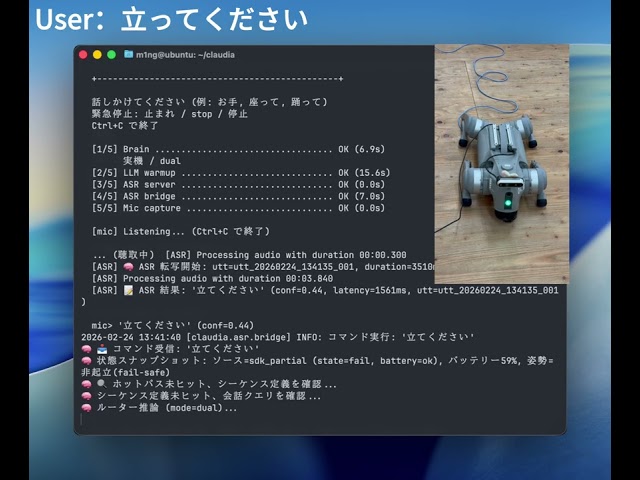
Voice → ASR → Local LLM → Robot Action — fully on-device, zero cloud dependency. Commands shown: Stand up / Sit / Lie down (Japanese voice input on Unitree Go2)
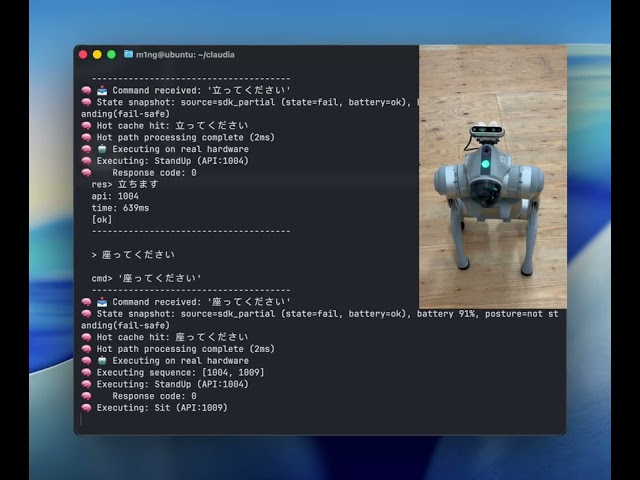
Interactive launcher → Keyboard mode → Japanese text commands → Robot Action. Commands shown: Stand up (立って) / Sit (座って) / Lie down (伏せて) / Hello (挨拶して)
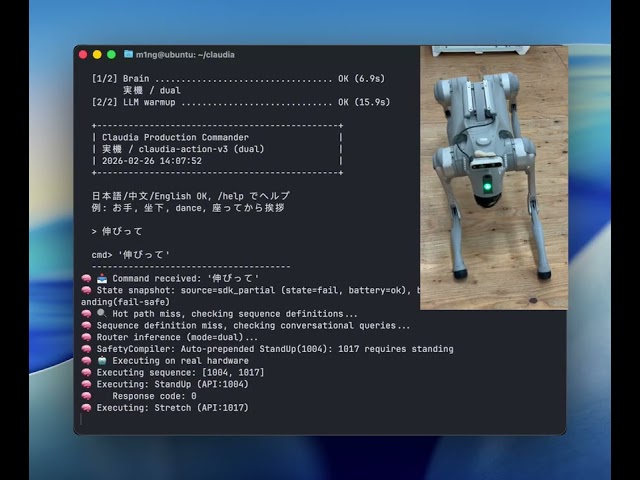
High-risk mode toggle (c) → Stretch / Front Jump / Front Flip — demonstrating SafetyCompiler gate control. Terminal mode shown here — voice and terminal share the same LLM pipeline, only the input method differs.
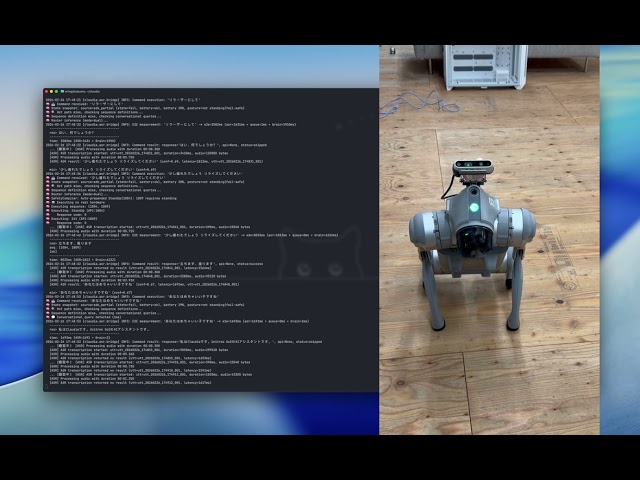
Fully wireless voice pipeline: DJI MIC 2 → ASR → Local LLM → Robot Action — zero wired connections (Wi-Fi + wireless mic).
- Semantic Understanding: Maps abstract concepts to robot actions (e.g., "可愛い" (cute) → Heart gesture, "疲れた" (tired) → Sit down)
- Direct API Output: LLM outputs structured JSON with action codes — no intermediate mapping layer
- Single Source of Truth: All 27 action definitions live in
action_registry.py; downstream sets (whitelist, standing requirements, method map) are auto-derived - Deterministic Inference:
temperature=0.0with JSON mode for consistent behavior
- Unified Safety Pipeline: All action paths go through
SafetyCompiler.compile()— no bypass possible - 3-Tier Battery Gating: <=10%: safe actions only | <=20%: no high-energy | <=30%: downgrade flips to dance
- Standing Prerequisites: Auto-prepends StandUp when needed (e.g., Hello requires standing)
- Virtual Posture Tracking: Tracks posture changes within action sequences for correct prerequisite insertion
- Whitelist Enforcement: Only registered, enabled actions can execute
- 18 Validated Actions: 8 basic postures + 7 performance + 3 advanced (see Supported Actions)
- Real-Time Control: 1ms (cached) to ~5s (LLM on Jetson) response time
- State-Aware Sequencing: Automatic action dependency resolution
- Graceful Fallback: Real hardware → Mock simulation, with structured error codes
- Japanese-Primary: Optimized for natural Japanese conversation (hot cache, response validation, ASR)
- Multilingual-Ready Architecture: Qwen2.5-7B natively understands Japanese, Chinese, and English
- Language Switching via ASR: Whisper language parameter configurable per session
- ASR Kana Normalization: Built-in KANA_ALIASES pipeline for speech recognition output cleanup
| Component | Requirement |
|---|---|
| Robot | Unitree Go2 (R&D Plus recommended) |
| Compute | NVIDIA Jetson Orin NX |
| OS | Ubuntu 20.04 (aarch64) |
| Python | 3.8+ |
| LLM Runtime | Ollama |
| Middleware | ROS2 Foxy + CycloneDDS |
| Network | Wi-Fi (TP-Link Archer T2UB Nano) or Ethernet (192.168.123.x) |
git clone https://github.com/ShunmeiCho/Claudia.git
cd claudia
pip install -e .

# Install Ollama (if not already installed)
curl -fsSL https://ollama.ai/install.sh | sh

# Create the Claudia brain model
ollama create claudia-7b:v2.0 -f models/ClaudiaIntelligent_7B_v2.0

# Set up environment
export RMW_IMPLEMENTATION=rmw_cyclonedds_cpp
export PYTHONPATH=/path/to/unitree_sdk2_python:$PYTHONPATH# Interactive launcher (recommended)
./start_production_brain.shThe launcher displays a mode selection menu:
==================================
🤖 Claudia Production Brain Launcher
==================================

🔧 網路配置:
   本機IP: 192.168.123.18
   機器人IP: 192.168.123.161 (Go2)
   DDS配置: eth0
   Python: /usr/bin/python3 (Python 3.8.10)

运行モード選択:
  1) キーボード + シミュレーション
  2) キーボード + 実機
  3) 語音 + シミュレーション
  4) 語音 + 実機
  c) 設定パネル
  t) 後台モード (tmux)
| Option | Mode | Description |
|---|---|---|
| 1 | Keyboard + Simulation | Type commands in REPL, actions logged but not sent to robot. For development and testing |
| 2 | Keyboard + Hardware | Type commands, execute on real Go2 via DDS. Prompts for connection confirmation |
| 3 | Voice + Simulation | USB mic → ASR → LLM pipeline, actions simulated. For voice pipeline testing |
| 4 | Voice + Hardware | Full pipeline: voice input → ASR → LLM → SafetyCompiler → real robot execution |
| c | Config Panel | Adjust settings before launch (see below) |
| t | Background (tmux) | Launch in a tmux session that survives SSH disconnection |
Option c opens a settings panel for runtime configuration:
| Setting | Default | Description |
|---|---|---|
| Wake word | OFF | Enable/disable "クラちゃん" wake word gating |
| Startup animation | OFF | Robot performs RecoveryStand + Hello on boot |
| LLM model | claudia-7b:v2.0 |
Select from available Ollama models |
| Routing mode | dual |
dual (action channel) / legacy (7B only) / shadow (A/B comparison) |
| ASR model | base |
base (~2-3s) / small (~5-8s) / medium (~10-15s) |
| High-risk actions | OFF | Allow FrontFlip, FrontJump, FrontPounce |
| Mic device | auto |
Auto-detect USB mic or specify manually (e.g., hw:2,0) |
./start_production_brain.sh --voice          # Voice + simulation
./start_production_brain.sh --voice-hw       # Voice + real robot

# Or run Python scripts directly:
python3 production_commander.py              # Keyboard + simulation
python3 production_commander.py --hardware   # Keyboard + hardware
python3 voice_commander.py                   # Voice + simulation
python3 voice_commander.py --hardware        # Voice + hardware
python3 voice_commander.py --asr-mock        # Voice + mock ASR (no mic)
python3 voice_commander.py --daemon # Background mode (for tmux)Claudia> こんにちは → Hello gesture (1016)
Claudia> 座って → Sit down (1009)
Claudia> 可愛いね → Heart gesture (1036) — semantic: "cute" triggers affection
Claudia> 立ってから挨拶して → Sequence: StandUp(1004) → Hello(1016)
Claudia> 疲れた → Sit down (1009) — semantic: "tired" triggers rest
Claudia> dance → Random Dance1(1022) or Dance2(1023)
Claudia> 量子力学について教えて → Conversational response (no action)
| API Code | Method | Japanese | Chinese | English | Standing Required |
|---|---|---|---|---|---|
| 1001 | Damp | ダンプモード | 阻尼模式 | Damp | - |
| 1002 | BalanceStand | バランス | 平衡站立 | Balance | - |
| 1003 | StopMove | 止まる | 停止 | Stop | - |
| 1004 | StandUp | 立つ | 站立 | Stand Up | - |
| 1005 | StandDown | 伏せる | 趴下 | Stand Down | Yes |
| 1006 | RecoveryStand | 回復 | 恢复站立 | Recovery | - |
| 1009 | Sit | 座る | 坐下 | Sit | Yes |
| 1010 | RiseSit | 起き上がる | 起立 | Rise Sit | - |
| API Code | Method | Japanese | Chinese | English | Standing Required |
|---|---|---|---|---|---|
| 1016 | Hello | 挨拶 | 打招呼 | Hello | Yes |
| 1017 | Stretch | 伸び | 伸懒腰 | Stretch | Yes |
| 1022 | Dance1 | ダンス1 | 舞蹈1 | Dance 1 | Yes |
| 1023 | Dance2 | ダンス2 | 舞蹈2 | Dance 2 | Yes |
| 1029 | Scrape | 刮る | 刮擦 | Scrape | Yes |
| 1033 | WiggleHips | 腰振り | 摇臀 | Wiggle Hips | Yes |
| 1036 | Heart | ハート | 比心 | Heart | Yes |
| API Code | Method | Japanese | Chinese | English | Risk |
|---|---|---|---|---|---|
| 1030 | FrontFlip | 前転 | 前空翻 | Front Flip | High |
| 1031 | FrontJump | ジャンプ | 前跳 | Front Jump | High |
| 1032 | FrontPounce | 飛びかかる | 前扑 | Front Pounce | High |
High-risk actions are battery-gated and require standing state. Disabled by default (
allow_high_risk=False).
Claudia runs on a Unitree Go2 quadruped robot with an external NVIDIA Jetson Orin NX as the AI compute module:
| Component | Specification |
|---|---|
| Robot | Unitree Go2 (12-DOF, 8000mAh battery, 4D LiDAR L2) |
| AI Module | NVIDIA Jetson Orin NX 16GB (Developer Kit) |
| GPU | 1024-core NVIDIA Ampere, 612MHz max, CUDA 11.4 |
| CPU | 8-core Arm Cortex-A78AE (aarch64) |
| RAM / Storage | 16GB LPDDR5 / 512GB NVMe SSD |
| OS | Ubuntu 20.04, L4T R35.3.1 (JetPack 5.1.1), Python 3.8.10 |
| LLM Runtime | Ollama + Qwen2.5-7B (Q4_K_M, ~4.7GB VRAM) |
| ASR | faster-whisper base (CPU int8, ~1.6s/utterance) |
| Microphone | DJI MIC 2 (wireless) or Audio-Technica AT2020USB-XP (USB wired) |
| Network | Wi-Fi (TP-Link Archer T2UB Nano, 192.168.123.x) — Ethernet no longer required |
As of the latest update, Claudia can operate with zero wired connections to the Jetson. All previously wired peripherals have been replaced:
| Connection | Previous (Wired) | Current (Wireless) |
|---|---|---|
| Network | Ethernet (eth0) | TP-Link Archer T2UB Nano (AC600, USB Wi-Fi + Bluetooth 4.2) |
| Microphone | Audio-Technica AT2020USB-XP (USB) | DJI MIC 2 (wireless, USB-C receiver) |
Wi-Fi setup reference: Jetson Orin NX Wi-Fi configuration guide (Qiita)
The TP-Link Archer T2UB Nano connects via USB and provides both Wi-Fi (for
192.168.123.xrobot network) and Bluetooth 4.2. The DJI MIC 2 provides broadcast-quality wireless audio with its dedicated USB-C receiver, eliminating the need for a wired USB microphone.
flowchart TD
    Input["User Input (JA / ZH / EN)"] --> Emergency{"1. Emergency Bypass<br/>~0ms"}
    Emergency -->|match| Stop["Immediate Stop"]
    Emergency -->|miss| Cache{"2. Hot Cache<br/>80+ mappings, ~1ms"}
    Cache -->|hit| Execute
    Cache -->|miss| Conv{"3. Conversational<br/>Detection"}
    Conv -->|"greeting / question"| TextOnly["Text Response<br/>(no action)"]
    Conv -->|command| LLM["4. LLM Inference<br/>(3-5s on Jetson)"]
    LLM --> Safety["SafetyCompiler.compile()<br/>whitelist / battery / standing"]
    Safety --> Execute["Execute Action"]
    Execute --> Robot["SportClient RPC<br/>via CycloneDDS"]
Routing modes (
BRAIN_ROUTER_MODE):dual(default, action-only model, ~30 tokens) |legacy(7B full response) |shadow(A/B comparison logging)
Module Overview (click to expand)
| Module | Responsibility |
|---|---|
brain/production_brain.py |
Core pipeline: cache → router → safety → execution |
brain/channel_router.py |
Dual-channel LLM router (legacy/dual/shadow modes) |
brain/action_registry.py |
Single source of truth for all action definitions |
brain/safety_compiler.py |
Unified safety pipeline (battery, standing, whitelist) |
brain/audit_logger.py |
Structured audit trail (logs/audit/) |
brain/mock_sport_client.py |
Simulates SportClient for testing |
robot_controller/system_state_monitor.py |
ROS2-based battery/posture monitoring at 5Hz |
robot_controller/unified_led_controller.py |
LED mode API (thinking/success/error/listening) |
production_commander.py |
Keyboard REPL entry point |
voice_commander.py |
Voice mode entry point: ASR + AudioCapture + ASRBridge |
audio/asr_service/ |
ASR server: faster-whisper + silero-vad + UDS |
Status: Phase 2 Operational — Full voice pipeline running on Jetson with USB microphone.
Wireless Mic (DJI MIC 2) or USB Mic (AT2020USB-XP), auto-detect card
  │ arecord subprocess → resample → 16kHz 960byte frames
  v
AudioCapture ──→ /tmp/claudia_audio.sock ──→ ASR Server (subprocess)
                                                ├── silero-vad + emergency detection
                                                ├── faster-whisper base (ja, beam=1, CPU int8)
                                                v
ASRBridge ←── /tmp/claudia_asr_result.sock ←─── JSON Lines
  ├── emergency → queue flush + cooldown → brain call (bypass lock)
  ├── transcript → confidence ≥0.35 filter → dedup → Queue(3)
  └── command worker → brain.process_and_execute(text)
- SIGHUP Handling: Both commanders ignore SIGHUP — SSH disconnection does not kill the process
- ASR Auto-Restart: If the ASR subprocess crashes, VoiceCommander automatically restarts the full pipeline (Bridge → Capture → ASR → rebuild). Up to 3 attempts before entering degraded mode (keyboard-only)
- tmux Integration:
start_production_brain.shoptiontlaunches in a tmux session with full environment forwarding. Survives SSH disconnection - Ollama GPU Cleanup: On shutdown, models are explicitly unloaded from GPU memory (
keep_alive=0) instead of occupying VRAM for 30 minutes
| Variable | Default | Options |
|---|---|---|
CLAUDIA_ASR_MODEL |
base |
base / small / medium |
CLAUDIA_ASR_BEAM_SIZE |
1 (greedy) |
1 / 3+ (beam search) |
CLAUDIA_ASR_DEVICE |
cpu |
cpu / cuda |
CLAUDIA_WAKE_WORD_ENABLED |
0 (off) |
0 / 1 |
CLAUDIA_WAKE_WORD_TIMEOUT |
5 (seconds) |
Listening window after standalone wake word |
- KANA_ALIASES Pipeline: Integrated into the hot cache layer. Normalizes common ASR kana outputs to their kanji equivalents (e.g.,
おすわり→お座り,おて→お手,はーと→ハート). Eliminates the #1 source of ASR mismatches with Japanese voice commands. - Japanese Suffix Stripping: Polite suffixes (です/ます/ください) are automatically stripped for hot cache matching (e.g.,
かわいいです→かわいい). - Emergency Command Kana Variants:
EMERGENCY_COMMANDSdictionary includes kana-only variants (とまれ,とめて,ていし) ensuring emergency stops work even with imperfect ASR transcription.
Status: Echo Gating Implemented — TTS echo gating implemented in ASR server. TTS provider integration planned for PR3 (VOICEVOX / Google TTS).
Responses are currently displayed as text in the REPL. The robot responds in Japanese (enforced by _sanitize_response()). The brain never touches TTS — ProductionBrain produces text + action code; TTS playback will be managed entirely in the commander layer.
| Component | Technology |
|---|---|
| LLM | Qwen2.5-7B via Ollama |
| Robot | Unitree Go2 + unitree_sdk2_python |
| Communication | CycloneDDS + ROS2 Foxy |
| Platform | NVIDIA Jetson Orin NX (aarch64) |
| Language | Python 3.8.10 |
| OS | Ubuntu 20.04 |
| GPU | CUDA 11.4 |
pip install -e ".[dev]" # Includes pytest, black, flake8, mypypython3 test/run_tests.py # All tests
python3 test/run_tests.py --type unit # Unit only
python3 test/run_tests.py --type hardware # Hardware only
pytest test/ -v # Via pytestblack --line-length 88 src/
flake8 src/
mypy src/ollama list | grep claudia # Check models
ollama ps # Running models
curl http://localhost:11434/api/tags # Ollama health check| Problem | Cause | Fix |
|---|---|---|
| Error 3103 | Unitree app occupying sport mode | Close the app and restart the robot |
| DDS connection failed | Wrong network config | Verify eth0 has 192.168.123.x, check RMW_IMPLEMENTATION |
| LLM timeout | Model not loaded | Run ollama list, check curl localhost:11434/api/tags |
| Import error (unitree_sdk2py) | Missing PYTHONPATH | export PYTHONPATH=/path/to/unitree_sdk2_python:$PYTHONPATH |
| Error 3104 | RPC timeout (async action) | Robot may still be executing; check connectivity |
| Action channel 10s timeout | Jetson GPU cold start | First command after idle; model re-warms automatically |
(聴取中) but no recognition |
Mic mute/low gain | Check mic gain, test: arecord -D hw:X,0 -d 3 /tmp/t.raw |
| ASR slow (>5s/utterance) | whisper-small on CPU | Use base (default): CLAUDIA_ASR_MODEL=base |
| Phase | Description | Status |
|---|---|---|
| PR1 | SafetyCompiler + action_registry + P0 safety fixes | Done |
| PR2 | Dual-channel LLM routing (action + voice separation) | Done |
| PR3 | ASR/TTS integration | ASR Done, TTS Pending |
| P2 | Parameterized actions (Move, Euler, SpeedLevel) | Planned |
| P2 | 3B action-channel A/B testing | Planned |
Claudia is built on the shoulders of these open-source projects:
- Qwen2.5 — multilingual LLM powering the robot brain
- Ollama — local LLM inference runtime
- Unitree SDK2 — Go2 robot control SDK
- faster-whisper — CTranslate2-based ASR engine
- silero-vad — voice activity detection
- ROS 2 Foxy + CycloneDDS — robot middleware
MIT License — see LICENSE for details.