Investigating the Impact of Distraction Types on Attention and Behavior in AR-based Trail Making Test


Sihun Baek · Zhehan Qu · Maria Gorlatova
Intelligent Interactive Internet of Things (I³T) Lab · Duke University
This is the official code repository for the ACM VRST 2025 paper
"AR-TMT: Investigating the Impact of Distraction Types on Attention and Behavior in AR-based Trail Making Test"

Despite the growing use of AR in safety-critical domains, the field lacks a systematic understanding of how different types of distraction affect user attention in AR environments. To address this gap, we present AR-TMT, an AR adaptation of the Trail Making Test that spatially renders targets for sequential selection on the Magic Leap 2.
- 🎯 AR Trail Making Test — virtual targets are spatially anchored with ArUco markers and selected in sequence
- 🧠 Three distraction categories — top-down, bottom-up, and spatial distraction, grounded in Wolfe's Guided Search model
- 👁️ Rich behavioral sensing — task performance, eye gaze, motor behavior, and subjective load measures
- 📡 Live data pipeline — real-time data transmission and egocentric video recording for offline analysis
The video below demonstrates all the stages of AR-TMT that we implemented — click to watch:
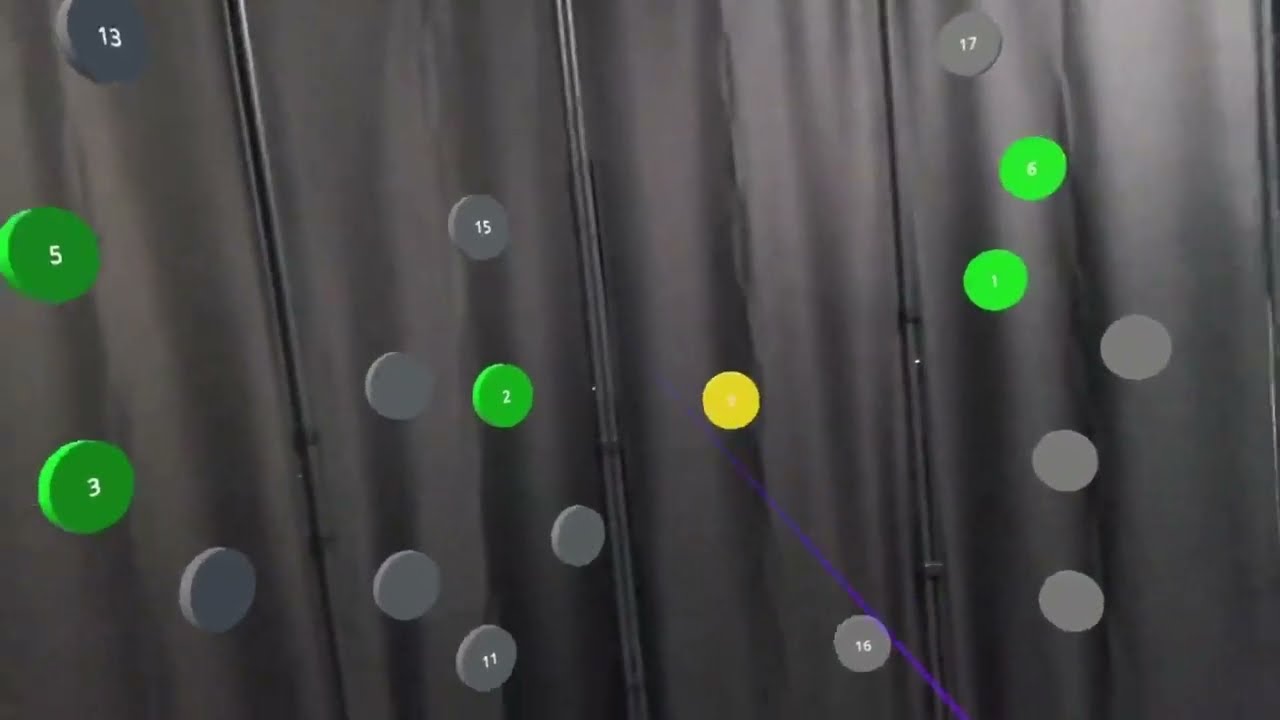
The source code of AR-TMT is available in Assets/Scripts/AR-TMT, organized as follows:
Assets/Scripts/AR-TMT
├── SharedInfomanager.cs          # Main script managing the overall AR-TMT flow
├── TargetGenerator.cs            # Target and distractor generator
├── ShootingAction_controler.cs   # Shooting (target-selection) action controller
├── EyeTrackerLogger.cs           # Eye-tracking data logger
├── DataTranmission.cs            # Data transmission to a local computer
├── MarkerDetection.cs            # ArUco marker detector to initiate and locate the test
├── PlaneDetectionMarker.cs       # ArUco marker detector for panel detection
├── NoticeHandler.cs              # Stage-description UI handler
├── SelectionNoticeHandler.cs     # Main selection UI handler
├── MotorSpeedTest/               # Visuomotor speed test
├── MLcameraTest/                 # Egocentric video recorder
├── Questionnaire/                # After-stage subjective ratings
├── WebRTC/                       # Real-time audio/video streaming
└── Prefab_file/                  # Target and distractor prefabs & visual effects
| Requirement | Version |
|---|---|
| Unity | 2022.3.48f1 |
| Magic Leap Unity SDK | 2.5.0 (embedded in Packages/) |
| Device | Magic Leap 2 |
- Clone this repository and open the project with Unity 2022.3.48f1.
- Open the main scene:
Assets/Scenes/AR-TMT.unity. - Build for the Android (Magic Leap 2) platform and deploy to the device.
If you use this work, please cite:
@inproceedings{baek2025artmt,
  title     = {AR-TMT: Investigating the Impact of Distraction Types on Attention and Behavior in AR-based Trail Making Test},
  author    = {Baek, Sihun and Qu, Zhehan and Gorlatova, Maria},
  booktitle = {Proceedings of the 31st ACM Symposium on Virtual Reality Software and Technology},
  series    = {VRST '25},
  year      = {2025},
  publisher = {Association for Computing Machinery},
  address   = {Montreal, QC, Canada},
  doi       = {10.1145/3756884.3765987}
}For questions or collaboration, please reach out to the authors:
- Sihun Baek — sihun.baek (AT) duke.edu
- Zhehan Qu — zhehan.qu (AT) duke.edu
- Maria Gorlatova — maria.gorlatova (AT) duke.edu
We thank the study's participants for their time in the data collection. This study was done in the Intelligent Interactive Internet of Things Lab at Duke University, and was approved by our institution's Institutional Review Board.
This work was supported in part by NSF grants CSR-2312760, CNS-2112562, and IIS-2231975, NSF CAREER Award IIS-2046072, NSF NAIAD Award 2332744, a Cisco Research Award, a Meta Research Award, Defense Advanced Research Projects Agency Young Faculty Award HR0011-24-1-0001, and the Army Research Laboratory under Cooperative Agreement Number W911NF-23-2-0224. The views and conclusions contained in this document are those of the authors and should not be interpreted as representing the official policies, either expressed or implied, of the Defense Advanced Research Projects Agency, the Army Research Laboratory, or the U.S. Government. This paper has been approved for public release; distribution is unlimited. No official endorsement should be inferred. The U.S. Government is authorized to reproduce and distribute reprints for Government purposes notwithstanding any copyright notation herein.